

CBD Side Effects in Elderly Adults
The researchers analyzing national statistics on health and drug use found that CBD use is more common than cannabis among people 65 years old and older. In fact, the fastest growth in cannabinoid use is among people 50 years old and older. The older population is looking for natural ways to manage health and wellness challenges without using opioids.
CBD use is growing among older people because, for seniors, the cannabinoids offer health and wellness benefits without causing addiction or a high like opioids. However, aging changes the way the body processes compounds, so CBD side effects in the elderly may be different than side effects in younger people. An added complexity is that seniors are more likely to be taking multiple prescription drugs. By understanding the differences, older adults can make an informed decision about using CBD.

TL;DR (Too Long; Didn’t Read):
CBD can cause side effects in older adults. If due to aging only, they are usually temporary and mild. In older adults, side effects may include reduced alertness, excessive sleepiness, nausea, diarrhea, changes in blood pressure, and more. It is important to note any side effects because they can increase the risk of falling.
Table of Contents
Why CBD Side Effects Can Be Different After Age 65
The aging process leads to changes in almost every organ and system. These changes directly influence how supplements and medications are processed.
For example, liver enzymes break down many medications and other substances, including CBD. Aging leads to less efficient liver function. CBD may stay in the body longer as the metabolism and excretion systems slow down.
The kidneys are also affected during aging. The kidneys are responsible for removing substances from the bloodstream. The glomerular filtration rate measures this rate. As the kidneys slow down and work less efficiently, the removal of substances slows down.
Metabolism slows with aging, but it can worsen due to heart conditions and drugs that inhibit CYP450 enzymes found mostly in the liver. These enzymes are needed to break down and convert drugs and CBD into metabolites. If CYP450 enzymes are compromised, CBD is cleared from the body at a slower rate. If the amount of the drug taken is not adjusted for the slowed metabolism, CBD will remain in the body longer than it should.
Also, people who are 65 years and older may experience different CBD side effects if they have certain diseases. The diseases may change how the body processes medications. It is the combination of changes to organ functioning and the treating medications that lead to different CBD side effects in older adults. For example, there is a combination of higher body fat, slower metabolism reducing liver enzyme action, slowed CBD elimination due to declining kidney function, and slower medication breakdown.
The endocannabinoid system (ECS), a major system regulator, changes with age in several ways. These include reduced receptor activity and signaling, reduced cannabinoid receptor density, and changes in enzymes. These changes affect how CBD is processed and the specific effects experienced. For example, according to an American Medical Association interview with geriatrician Alison Moore, MD, age-related physiological changes may mean that older adults require a lower cannabis dose to achieve the intended effect or that cannabinoids remain in their system longer than they would in younger adults.
A factor potentially causing different side effects in aging adults is the natural change in body composition. Older people have less muscle mass and body water and more body fat. CBD is highly fat soluble, so it accumulates in body fat. This reduces CBD bioavailability and increases the side effects of water-soluble medications.
Common CBD Side Effects in Elderly Adults
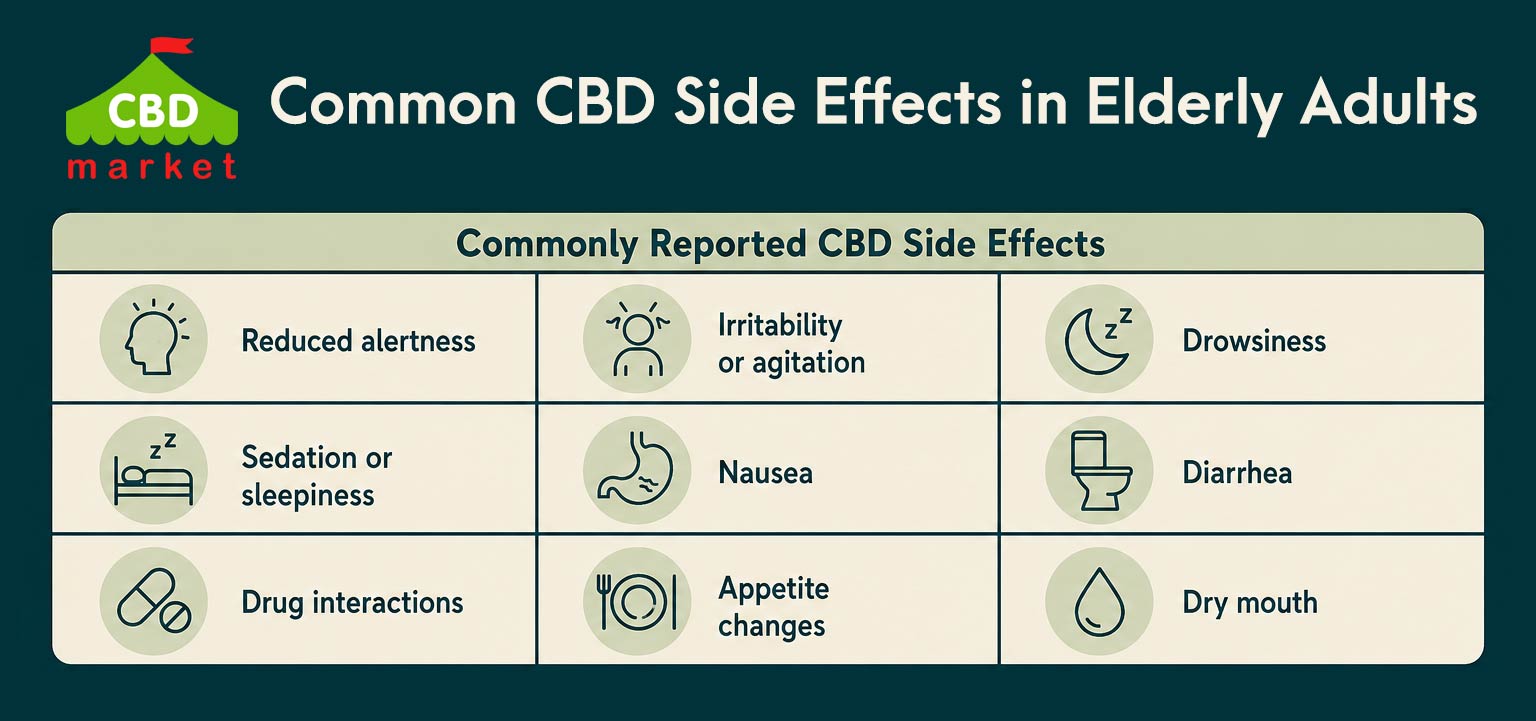
Most research has found CBD is well-tolerated. Anecdotal evidence and some clinical research indicate people over 65 years find relief for various wellness issues, including relief and improved sleep. Yet, side effects can occur.
The following are some of the most commonly reported CBD side effects in the elderly.
- Reduced alertness
- Irritability and agitation
- Drowsiness (natural feeling of being ready to sleep)
- Sedation (CBD-induced feeling of relaxation or sleepiness)
- Nausea mostly occurs when taking a high CBD dose
- Diarrhea increases risk of dehydration, weakness, and confusion
- Drug interactions
- Changes in appetite may increase or decrease
- Dry mouth may cause dental problems
Long-term CBD use may cause liver injury. CBD may also increase the level of certain medications, like the blood thinner Coumadin. Elderly adults are advised not to mix CBD with antidepressants, opioids, benzodiazepines, and some cholesterol medications. The most common side effect of mixing CBD with certain drugs is eventual changes in liver enzymes.
Another effect is dizziness when CBD is mixed with cardiovascular medications and leads to a drop in blood pressure. Some seniors may experience daytime fatigue when CBD is taken with other medications that promote relaxation.
A Side Effect is Not Always Caused by CBD
CBD does not always cause side effects in seniors taking CBD. For example, diarrhea may be caused by the product’s carrier oil. MCT oil and coconut oil can cause diarrhea in seniors with digestive issues because they act like laxatives.
Approximately 20% of adults ages 40 to 79 and 40% who are 65 years and older take five or more prescription medications. Some medications may interact with each other and produce side effects that may have nothing to do with CBD. Each day, over 750 adults 65 years and older are hospitalized for reactions to medications.
Sometimes, the CBD product’s quality is a factor. Low-quality products may contain toxic ingredients, like pesticides and heavy metals, or more THC than the label says on full spectrum products. It is always important to only take products that are third-party laboratory tested and provide a Certificate of Analysis (COA).
Underlying health conditions may also be the primary cause of side effects. Dehydration, infections, and chronic diseases can have symptoms like dizziness, fatigue, appetite changes, and digestive issues.
When to Stop Taking CBD and Contact a Clinician
It is important to stop taking CBD when you experience any of the following.
- Repeated falling
- Severe dizziness
- Reduced alertness
- Drowsiness that interferes with a normal lifestyle
- Daytime fatigue
- Confusion that persists
- Indications of liver issues, like dark urine
- Persistent nausea or diarrhea
- Unusual bleeding or bruising
All seniors should talk to their doctor before taking CBD and if they experience any of the side effects listed. It is especially critical if you take multiple prescription drugs.
Safe CBD Use for Seniors Begins with Awareness
CBD side effects in the elderly may be due to the body’s normal changes associated with aging, chronic illness, or how the body processes medications. Common side effects include drowsiness, sleepiness, diarrhea, nausea, reduced alertness, appetite changes, etc. Most side effects are mild, and they may go away after taking CBD for a while. Seniors should always talk to a doctor first, start with a low dose, buy only high-quality products, and note any physical or mental changes.
Sources
- https://pmc.ncbi.nlm.nih.gov/articles/PMC12095604/
- https://pmc.ncbi.nlm.nih.gov/articles/PMC8344100/#S22
- https://pmc.ncbi.nlm.nih.gov/articles/PMC11603750/#s5
- https://pmc.ncbi.nlm.nih.gov/articles/PMC8344100/
- https://pmc.ncbi.nlm.nih.gov/articles/PMC8344100/
- https://library.samhsa.gov/sites/default/files/pep22-06-04-003.pdf
- https://www.mayoclinic.org/healthy-lifestyle/consumer-health/expert-answers/is-cbd-safe-and-effective/faq-20446700
- https://pmc.ncbi.nlm.nih.gov/articles/PMC8298645/#Sec5
- https://www.aarp.org/health/drugs-supplements/polypharmacy-deprescribing-drugs/
Share this post
